Il più grande evento di pallanuoto giovanile al mondo: riservato a U9, U11 e U13, si tiene ogni anno a Lignano Sabbiadoro (UD) e attira squadre dai 5 continenti.
Quando è in programma il prossimo Festival?
Dal 13 al 20 giugno la settimana dedicata a U9 e U11, dal 20 al 27 giugno quella per gli U13.
Maschi e femmine giocano insieme?
Ai tornei U9 e U11 partecipano squadre femminili, maschili e miste. L’evento U13 è diviso in un torneo esclusivamente femminile e in uno per squadre solo maschili o miste.
Come ci si iscrive al Festival?
Visita la pagina dell’evento che interessa alla tua squadra (U9-U11 o U13) e segui la Guida alla Registrazione: contiene informazioni, obblighi, costi e scadenze. Ogni club può iscrivere più di una squadra nel singolo torneo.
Dove alloggiano le squadre durante il Festival?
Le squadre, composte da giocatori, allenatori e dirigenti, sono tutte sistemate all’interno del Bella Italia & EFA Village. Genitori, familiari e tifosi al seguito della squadra possono entrare nel villaggio pagando l’ingresso.
Cos’è il Passaporto del Campione?
È un codice etico: contiene i valori dello sport da rispettare per far parte della comunità HaBaWaBa.
Qual è l’obiettivo del progetto HaBaWaBa?
Diffondere i valori dello sport tra i bambini e creare un legame profondo con la pallanuoto attraverso un’esperienza indimenticabile.
Interview with Lee Shuwei, president of the Chengdu club: “Our waterpolo must open up to the world, Lignano is the best place to do it”
ShineAquatics Club was the break-out team of the HaBaWaBa International Festival 2026. The squad from Chengdu — the first Chinese team ever to participate in the event in Lignano Sabbiadoro, Italy — finished in 6th place overall in the mixed U13 tournament. They demonstrated the enormous potential of waterpolo in the People's Republic of China and proved once again the effectiveness of the “game of the ball in the water” project in developing waterpolo worldwide. The HaBaWaBa rules, which emphasize technical skills and dynamism over physical strength, were one of the elements that allowed Shine to face and defeat opponents from all over the world, particularly from countries with a massive waterpolo tradition.
Shine’s success would not have been possible without the work of Daniele Ferri, an Italian coach who moved to China in 2022 after his exceptional work as head coach of the Thailand women's national team. Betting on Ferri was Lee Shuwei, President of Shine Aquatics Club and teacher in the Swimming Teaching and Research Department at Chengdu Sports University. The team from the “city of pandas” thus began a growth journey that led them to become champions of Chengdu first, then of the Sichuan region, and finally of all of China. HaBaWaBa was the next step. We spoke with Lee Shuwei about Shine's experience at the 2026 Festival.
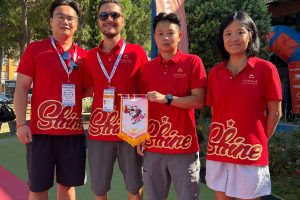
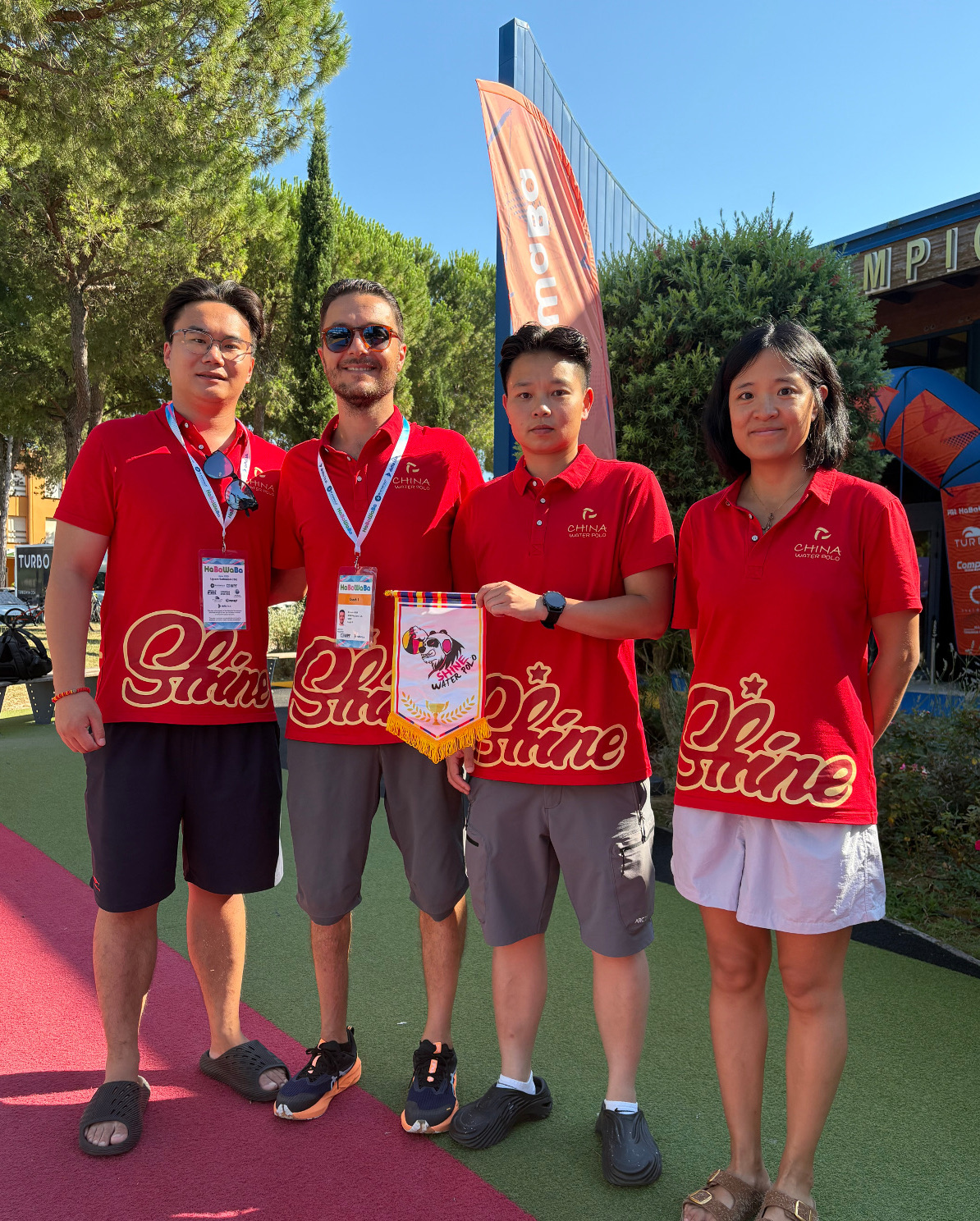
President, how does it feel to see Shine perform so well at HaBaWaBa?Shine's staff at HaBaWaBa: assistant coach Ding Jiawei, coach Daniele Ferri, President Lee Shuwei e team manager Amber Yan.
It was incredible, we didn't expect it. We knew about HaBaWaBa — we organized the HaBaWaBa China event in Chengdu in 2023 — but Daniele told us many times to participate because it's a high-level competition. We've been promoting waterpolo in China for eight years, and it's tough work: by participating in the Festival, we hoped to help introduce it to other teams. We are very committed to developing waterpolo among children in China, and we are in contact with coaches from other cities interested in following the same path, so Daniele and I often find ourselves traveling to other provinces. But it's not easy because China is huge: in Chengdu we have other clubs, but outside the city, the closest club is in Guangxi, 2,000 kilometers away.
Did you think you could be this competitive at HaBaWaBa?
Before coming, I knew the level of HaBaWaBa; we had watched the videos of the finals online, but we came just to try, to take a first step. We imagined there would be a few strong teams here at the Festival, four or five, but not so many. We didn't know the level was this high, but you can only understand that if you actually come to HaBaWaBa. Besides, during our tournament path, we happened to face some of the strongest teams: all the teams we played against finished in the Top 16, and three of them even in the Top 8. That was better for us. In the first two days, we played against very strong teams like Rapallo and Szentes, and that allowed the kids to wake up and adapt. Furthermore, being here helped us grow in terms of team building, in becoming a unified team. Reaching this in just one or two years is a difficult goal, also because in China kids have important school exams during this period.
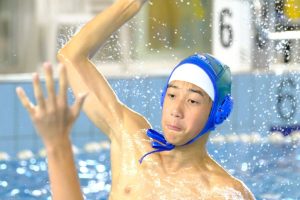
To come to Italy, families had to request special permission from the school, right?Shine player during the U13 tournament.
Daniele did an enormous amount of work with the coaches and also with the parents to make them understand that their children had the opportunity to participate in such an important competition. And yes, the parents had to request special permission from the school to send their children to the Festival: some of the kids are 12 years old, and in June, they are mid-semester in their final year of primary school.
What does Shine's result represent for Chinese waterpolo?
It's an example. We need to show people — even U15 or U18 coaches — that in terms of experience, 5 or 6 days in this kind of tournament are worth an entire year of competition in China. The same goes for the senior level. For me, seeing Shine here is exciting; it's historic. It's important to showcase the Festival in China and make sure other teams participate next year: HaBaWaBa opens your mind. It's important that more Chinese teams experience this kind of environment and this level of competition.
Do you think the HaBaWaBa rules helped Shine when competing against foreign teams? Is HaBaWaBa the best event to measure yourselves against "other countries'" water polo?
It's perfect for the kids, firstly because when you are young, you have to learn step by step. Moreover, with these rules — especially the 5-second rule at center-forward — all players have to move and be involved in the game: you can't just have one good player and leave the others doing nothing. Everyone has to swim, move, shoot, and pass. These rules are perfect for children starting out in waterpolo.
Shine won over the experts with a very dynamic style of play.The special T-shirt Shine players wore during HaBaWaBa 2026.
That is the reason I invited Daniele to China. He did the same work in Thailand and knows Asian water polo very well. In China, we have invited coaches with great resumes, but often they fail to adapt to our reality. Daniele did, and he then convinced us to come here, because a young waterpolo player can't just train in swimming, shooting, or tactics. To acquire real knowledge, they need something like HaBaWaBa. But I needed it too: participating in the Festival made me understand more about this sport; it opened my mind.
Would you suggest that other Chinese teams come to HaBaWaBa?
Of course. And as for Shine, I plan to participate with the girls' team next year. Hopefully, we can come with two teams next year and even more in the future.
Having experienced HaBaWaBa, what do you suggest Chinese waterpolo should do to improve?
We need a competition similar to HaBaWaBa. The Festival has a winning formula, first and foremost because of its rules, and also because every team has the chance to win a trophy. Even after losing a game in the morning, you can keep playing in the afternoon. For China, it would be a great idea to promote competitions with this format because it would allow the kids to play as many matches as possible. For the same reason, international competitions for Asian clubs should be organized: in Japan, Korea, and Singapore, there are youth water polo teams, but there is no real cooperation between countries. We need to collaborate and open up. If Shine hadn't opened up to HaBaWaBa, if I hadn't listened to Daniele, we wouldn't have seen what our kids are capable of. Lastly, something needs to change in our mindset: in China, we only focus on winning and don't understand that a defeat can still be a victory, because it can make you stronger and help the kids in the future — both as athletes and as people. It's better to face very strong teams, even if you might lose, than to win by 10 or 15 goals. That's the only way kids can improve and grow. In China, Shine has no rivals of the same level, whereas it would be important to build other strong teams in China and have the opportunity to lose. That's the only way to improve, and I saw that at HaBaWaBa.